HONOLULU (AP) — Kaʻiulani Murphy is quick to spot white terns flapping their wings when she's guiding Polynesian voyaging canoes across the Pacific.
The birds hunt for food at sea and lay eggs on land. So traditional navigators like her, who look to the stars, waves and other elements in nature to pilot across the ocean, see the bird's presence as a sign that land is near.
These days voyagers returning to Honolulu have more white terns to track than at any other time in modern history. New data shows their numbers have jumped more than 50% in the past decade — evidence the seabirds are thriving amid the concrete towers, traffic-clogged roads and Waikiki hotels in the state’s largest metropolis.
They're defying the fate of many other native birds in Hawaii, where disease and predators that aren't native to the islands have caused indigenous bird numbers to collapse.
“This is our big city,” said Murphy, who has navigated canoes to Tahiti, Japan and Rapa Nui. “It’s crazy to me that they’re getting to such a big population within Honolulu.”
There were 691 eggs and chicks in Honolulu trees as of this week, said Rich Downs, coordinator of the volunteer organization Hui Manu-o-Kū.
The group takes its moniker from the Hawaiian name for the white tern, which means “bird of Kū,” the god of war.
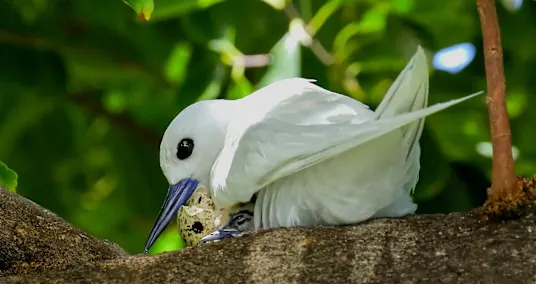
Manu-o-Kū can breed year round, but activity peaks from winter into early spring. They're the only seabirds that don't build nests, but instead lay their eggs on bare tree branches, cliff ledges or window sills. After hatching, the young sit on a branch until they can fly, their strong claws helping them hold on even in strong storms.
They're found near islands in warm waters around the world, but in Hawaii they live mostly among remote, primarily uninhabited atolls in the northwest. The only place they've settled among the archipelago's larger islands is Oahu, which is home to 1 million people.
Scientists aren't sure why the birds are thriving in Honolulu. The city might be hospitable because humans have reduced the numbers of predators like rats and cats around restaurants and buildings. Busy roads can also deter predators. Barn owls and mongoose, other species that like to feed on terns, are rare in the urban core.
“All the lights and the noise, the commotion of people and traffic, and things like that, doesn’t seem to bother them,” said Eric VanderWerf, the executive director of Pacific Rim Conservation, a nonprofit that supports native birds in Hawaii and the Pacific.
Downtown trees offer favorable habitat. A cup created by the scar tissue of a trimmed tree branch is an ideal place for an egg, so well-maintained trees create plentiful homes.
The most recent population survey, conducted by Hui Manu-o-Kū in 2023 but unpublished until now, showed Oahu's population of breeding adults jumped 1.5 times to 3,600 compared to 2016.
It offers a stark contrast with Hawaii’s other native birds. Since humans arrived in Hawaii, 71 of 113 bird species found only on the islands have gone extinct. Those remaining are often listed as threatened or endangered. Many are found in small numbers in higher elevation forests.
While native to the islands, manu-o-Kū were not observed breeding on Oahu until 1961, when scientists saw a pair of adults with a single egg.
Decades later, as the bird's population soared, Honolulu named manu-o-Kū its official bird in 2007. School children sing songs about the species. An annual festival celebrates them every May.
Hui Manu-o-Kū staff tie blue plastic ribbons around the trunks of trees hosting eggs and chicks to alert tree trimmers to stay clear. The ribbons also help bird-watchers keep track of the white terns, as does an online map.
For eight years, Joyce Hsieh's been taking photos of the birds as they incubate their eggs, feed young birds and raise hatchlings. One of her preferred spots is a Target parking garage, because she can drive up to the third floor to reach the same level as the birds in nearby trees.
White terns have about the same body length as pigeons but a larger wingspan. They fly up to about 120 miles (193 kilometers) from land and feast on small fish and squid chased to the ocean surface by larger species like tuna.
Murphy, the traditional voyager, is Native Hawaiian. She sees parallels between Hawaii's birds and her people.
Diseases introduced by the first Europeans killed Native Hawaiians in vast numbers in the 1800s. But Hawaiians — resilient and adaptive like manu-o-Kū — are still here, and their population is growing.
When she encounters the birds offshore en route to Oahu, she said it's like seeing old friends.
“It’s just a special feeling,” she said.
LATEST POSTS
- 1
 Dominating Monetary Administration: A Bit by bit Manual for Making an Individual Financial plan
 - 2Americans generally like wolves − except when we’re reminded of our politics
- 3Solid Living Tips: Experiences from a Wellness Fan
- 4Famous Restroom Beautifying Styles For 2024
- 5Meet Beef the bulldog, who takes slow walks with his 78-year-old friend


- Figure out How to Get a good deal on Your Rooftop Substitution Venture
- Two UN peacekeepers killed in explosion in Lebanon
- Courageous Climbing: Trails and Stuff for Outside Lovers
- Figure out How to Adjust Work, Life, and an Internet based Degree
- Volunteers aiding humpback whale stranded in Baltic get death threats
- Figure out How to Alter Your Volvo XC40 for Further developed Solace
- American tourists left stranded in the Caribbean following flight cancellations after airspace closed for Maduro operation
- Astronomers discover never-before-seen celestial object: "Cloud 9"
- Under pressure at home, Belgium's leader treads a tight rope with EU partners over funds for Ukraine